Description
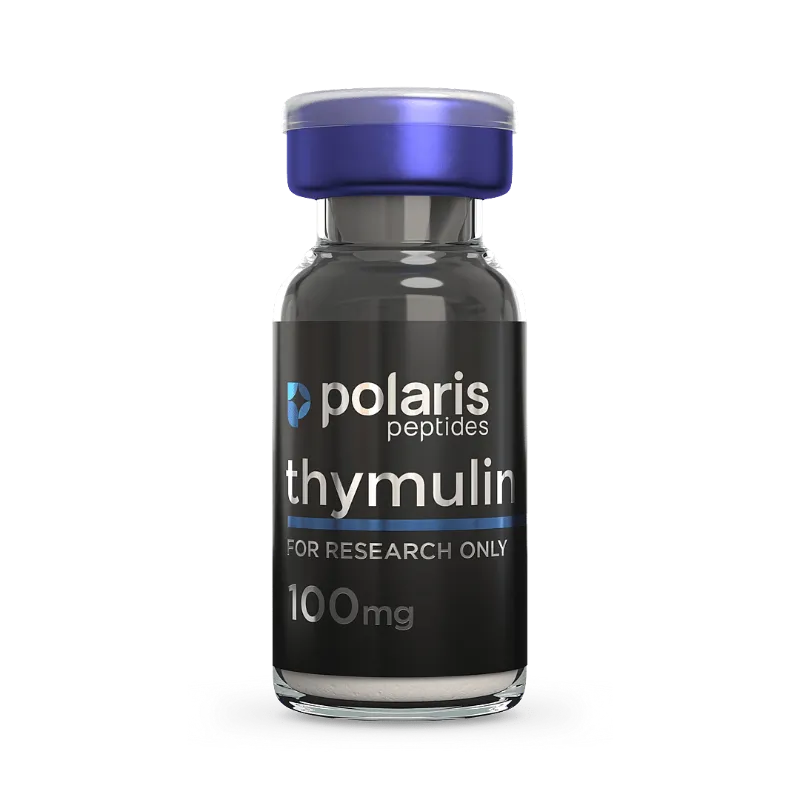
Thymulin 100mg is a 100mg vial of Thymulin, a zinc-dependent thymic nonapeptide, supplied as freeze-dried powder. It’s sold for laboratory research only.
Our old listing added the name thymalin in brackets. Thymalin is a separate thymus extract from Russian research, and the two names often get mixed up. This product is sold as thymulin.
About Thymulin
Thymulin is a nine-amino-acid peptide made by epithelial cells in the thymus. Jean-Francois Bach’s group in Paris described it in the 1970s as facteur thymique serique (FTS), a thymus factor found in blood.
It only works when it’s bound to zinc, which is why older papers separate the active zinc form from the inactive peptide. Blood levels fall with age as the thymus shrinks. It isn’t an approved medicine.
How Thymulin acts in the lab
Thymulin binds high-affinity receptors on T cells and pushes them through the later stages of maturation. Zinc holds the peptide in the shape that receptor recognizes.
It also talks to the neuroendocrine system. The pituitary hormones prolactin and growth hormone raise thymulin output, and thymulin in turn affects pituitary hormone release in animal studies.
Thymulin 100mg technical data
- Compound: Thymulin
- Also known as: facteur thymique serique, FTS
- CAS number: 63958-90-7
- Molecular formula: C33H54N12O15
- Molar mass: 858.9 g/mol
- Sequence: pGlu-Ala-Lys-Ser-Gln-Gly-Gly-Ser-Asn
- Amount: 100mg per vial
- Form: lyophilized (freeze-dried) powder
- Purity: over 99% (HPLC-MS)
- Packaging: vacuum-sealed
- SKU: PP-THYMU-100
- Use: laboratory research only
What the research says about Thymulin
Most of the early work looked at T cells: thymulin helps immature T cells mature and gain their surface markers, and levels drop in zinc deficiency and in older animals.
Later rodent studies looked at anti-inflammatory and pain effects, and a few groups used thymulin gene therapy in aging rats to study the link between the thymus and the brain’s hormone systems.
To read the papers yourself, start with this PubMed search for Thymulin.
Thymulin compared with similar compounds
Here’s how Thymulin 100mg fits among related compounds. Thymulin is a zinc-dependent nine-amino-acid thymus hormone that drives T-cell maturation. By comparison:
- Thymosin Alpha-1 is a 28-amino-acid thymus peptide studied for T-cell and antiviral responses
- LL-37 is the human cathelicidin, an antimicrobial peptide that also signals to immune cells
Two of these come from the thymus and act on T cells. LL-37 works at barrier surfaces like skin and gut, killing microbes directly and signaling to immune cells. See them all on our immune peptides page.
How Thymulin 100mg is tested
We test Thymulin 100mg by HPLC-MS, which pairs liquid chromatography with mass spectrometry. The first part measures purity and the second confirms the molecule is the right one. Thymulin 100mg tests at over 99% purity.
After freeze-drying, each vial is vacuum-sealed. Keeping air and moisture out is what lets lyophilized peptide stay stable for months in a freezer.
Keep a record of the batch number on each label. Matching results to batches is the simplest way to rule out the material when an experiment doesn’t behave.
Reconstituting Thymulin 100mg
The amount of liquid you add sets the concentration. For a vial holding 100mg:
- 2mL of bacteriostatic water gives 50mg/mL
- 3mL of bacteriostatic water gives 33.33mg/mL
- 5mL of bacteriostatic water gives 20mg/mL
Choose the volume that suits your measurements. Mark the vial with the concentration and date so nobody has to guess later.
Bacteriostatic water is the usual choice. Add it slowly so it runs down the side of the vial, then swirl or roll until everything dissolves. Shaking can shear peptide chains. Skip it.
Thymulin 100mg storage and shelf life
Freeze-dried Thymulin 100mg handles room temperature fine during shipping, but for anything longer keep it in a freezer at -20°C, away from light. Once mixed, keep it in the fridge at 2 to 8°C and use it within 28 days.
If you keep several vials going at once, store them upright in a closed box so they stay out of the light and don’t get knocked over every time the fridge opens.
Thymulin sizes compared
- Thymulin 10mg: $40.00, about $4.00 per mg
- Thymulin 100mg (this page): $185.00, about $1.85 per mg
For longer projects a larger vial like Thymulin 100mg means fewer vials to mix and fewer reorders.
Save on Thymulin 100mg in bulk
Ordering for a longer study? Bulk packs of Thymulin 100mg cut the price per vial:
- 1 vial: $185.00
- 2 vials: $333.00, about $166.50 per vial (save 10%)
- 5 vials: $786.25, about $157.25 per vial (save 15%)
- 10 vials: $1,424.50, about $142.45 per vial (save 23%)
- 15 vials: $2,053.50, about $136.90 per vial (save 26%)
- 20 vials: $2,590.00, about $129.50 per vial (save 30%)
The 20-vial pack brings the price down by 30%. Packs ship as individual sealed vials, so you only open what you need.
Often ordered with Thymulin 100mg
- Thymosin Alpha-1 10mg, a thymic peptide
- LL-37 10mg, an antimicrobial peptide
- KPV 10mg, an alpha-MSH tripeptide
- BPC-157 TB-500 Blend 10mg/10mg, BPC-157 and TB-500 in one vial
- Retatrutide 5mg, a triple agonist
Browse the full immune peptides range, or see every product on our research peptides page.
Thymulin 100mg FAQ
How much is in the Thymulin 100mg vial?
100mg of freeze-dried powder. The amount is printed on the label.
Is there a bulk discount?
Yes. Choose 2, 5, 10, 15 and 20 vials in the Quantity menu and save between 10% and 30% per vial.
How pure is Thymulin 100mg?
Over 99% by HPLC-MS. The same test confirms the molecular weight, so it checks identity too.
What do I mix Thymulin 100mg with?
Sterile bacteriostatic water is the usual choice. The reconstitution section above shows the concentration for each volume.
How should I store it?
Keep sealed vials in the freezer at -20°C. Once mixed, refrigerate at 2 to 8°C and use within 28 days.
Order Thymulin 100mg today
Ready to order? Thymulin 100mg costs $185.00 and is in stock. Add it to your cart and you’re done. Ordering more? Packs of up to 20 save up to 30%.
Need more for the same project? See the rest of our immune peptides.
For laboratory research use only. Not for human or veterinary use. These statements have not been evaluated by the FDA.


Reviews
There are no reviews yet.