
Polaris Peptides TB-500: the vial and the blend
Polaris Peptides TB-500 comes as a 10mg vial, over 99% pure by HPLC-MS, and in four blends with BPC-157. Here is what TB-500 is, what the research has looked at and how to order it.
What is Polaris Peptides TB-500?
TB-500 is the research name for synthetic thymosin beta-4 and fragments of it. Thymosin beta-4 is a 43-amino-acid protein found in almost every cell, with high levels in platelets and white blood cells. Inside the cell it binds actin, the protein cells use to change shape and move.
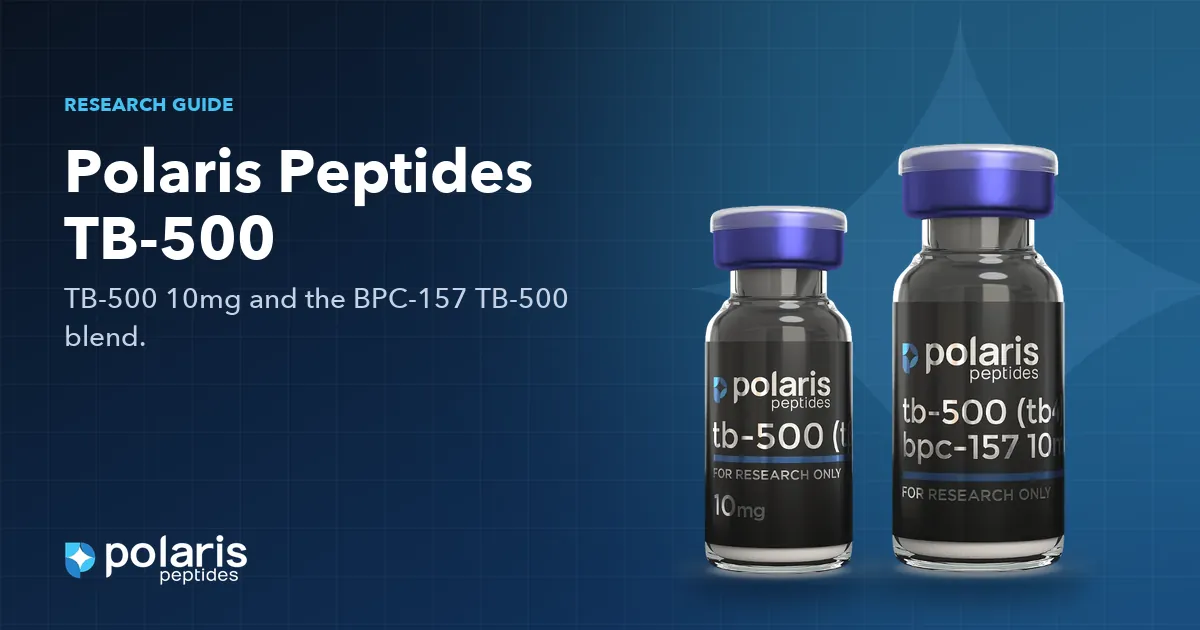
Polaris Peptides TB-500 is freeze-dried in a vacuum-sealed 10mg vial and sold for laboratory research only.
Polaris Peptides TB-500 price and blends
- TB-500 10mg: from $70 (on sale)
- BPC-157 TB-500 Blend 10mg/10mg: from $110
- GLOW Blend 50mg (GHK-Cu, TB-500, BPC-157): from $89
- GLOW Blend 70mg (GHK-Cu, TB-500, BPC-157): from $99
- KLOW Blend 80mg (GHK-Cu, KPV, TB-500, BPC-157): from $125
TB-500 10mg comes in packs of 2 to 20 at up to 30% off, about $49 a vial at 20. The BPC-157 TB-500 blend saves a reconstitution step when you study both peptides together.

What the TB-500 research has looked at
Allan Goldstein’s group at George Washington University did much of the early thymosin beta-4 work. A 1999 rat study by Malinda and colleagues reported faster wound closure, and later studies looked at heart, eye and hair follicle repair. Most of the work is in animals and cell culture. Start with this PubMed search for thymosin beta-4.
How TB-500 works
Thymosin beta-4 holds actin monomers in reserve so cells can build their internal scaffolding quickly when they need to move. That’s why it shows up in studies on cell migration into wounds and on new blood vessel growth.
Mixing and storing Polaris Peptides TB-500
Add sterile bacteriostatic water slowly down the glass and swirl until clear. 2mL in the 10mg vial gives 5mg/mL. Keep sealed vials at -20°C and mixed vials in the fridge for up to 28 days.
Polaris Peptides TB-500 specifications
- Compound: TB-500 (synthetic thymosin beta-4)
- CAS number: 77591-33-4
- Amount: 10mg per vial
- Form: lyophilized powder, vacuum-sealed
- Purity: over 99% by HPLC-MS
- Packs: 2 to 20 vials, 10% to 30% off
- Use: laboratory research only
TB-500 compared with BPC-157
The two are often studied together because they work in different ways. TB-500 acts through actin and cell movement. BPC-157 is linked to blood vessel growth and nitric oxide signaling. Running both in one model covers two steps of repair at once.
If you want both, the BPC-157 TB-500 blend saves a vial and a mixing step. If you’d rather control each amount, order Polaris Peptides TB-500 and BPC-157 as separate vials.
Calculating TB-500 concentrations
- 10mg vial + 1mL water = 10mg/mL
- 10mg vial + 2mL water = 5mg/mL
- 10mg vial + 3mL water = 3.33mg/mL
Polaris Peptides TB-500 picks at a glance
TB-500 10mgFrom $70 BPC-157 TB-500 Blend 10mg/10mgFrom $110
 GLOW Blend 50mgFrom $89
 BPC-157 10mgFrom $60
Planning a TB-500 order
Work out the total amount your study needs across every arm and time point, then divide by 10mg to get the number of vials. Add one spare. If the answer is five or more, a pack is cheaper than singles: 5 vials save 15%, and 10 save 23%. Keep the sealed vials frozen and mix one at a time, since a mixed vial should be used within 28 days.
Polaris Peptides TB-500 FAQ
How much is Polaris Peptides TB-500?
TB-500 10mg is $70, down from $80. Packs of up to 20 save up to 30%.
What’s the difference between TB-500 and thymosin beta-4?
TB-500 is the name used for synthetic thymosin beta-4 and for short fragments of its active region.
Can I buy TB-500 with BPC-157?
Yes. The BPC-157 TB-500 blend has 10mg of each, and GLOW and KLOW include both.
Is TB-500 for human use?
No. It’s sold for laboratory research only, and it’s on the WADA prohibited list.
Related reading: Polaris Peptides BPC-157 and the healing and recovery peptides range.
Buy TB-500 from Polaris Peptides
TB-500 10mg, over 99% pure and in stock, with packs up to 30% off.
Polaris Peptides products are sold for laboratory research use only. They aren’t for human or veterinary use and haven’t been evaluated by the FDA.